
Wholesale Cashew for Pasalubong Producers: Matching Grade to Product (2026)

Updated: 1 day ago
A procurement-side framework for matching cashew grade to finished-product application. Quick answer. Philippine pasalubong production uses cashew across applications where the kernel is visible in the finished product (premium gift packs, garnish placements) and applications where it is chopped, ground, or folded into the matrix (polvoron, hopia fillings, fruit cake, brittle, paste bases). For the second group, SP grade (Small Pieces) cashew is functionally equivalent to W320 or W240 at a lower input cost per kilogram. SP is the same cashew, processed in the same facility under the same food safety standards, simply pre-broken to AFI standard sieve specifications. The framework below helps procurement teams map each SKU in the portfolio to the right grade based on finished-product application, not legacy specification. Cashews.PH supplies SP grade from a 20 kilogram minimum order. Request a sample and quote. Cashew prices have become more expensive into 2026. For procurement and product development teams at Philippine pasalubong manufacturers running multiple cashew SKUs, that movement is a reason to surface a question that procurement reviews periodically: are the cashew grade specifications across the portfolio still the right ones for the finished products they support?
Some teams will already have aligned their specifications carefully. Others will have inherited grade choices made years or decades ago and will be reviewing them for the first time. Both are common. What follows is a procurement-side framework for that review, regardless of where a team currently sits.
The central question in the framework is straightforward: for each cashew SKU in the portfolio, does the customer see a whole kernel in the finished product, or do they taste cashew without seeing it as a piece? The answer determines which grade serves the SKU most efficiently.
When the customer sees the whole kernel (premium gift boxes, garnish placements, visible toppings on premium pastries), whole grades such as W180, W240, or W320 are the right specification, and the kernel size is part of the product promise. When the customer does not see a whole kernel (cashew polvoron, hopia fillings, fruit cake, brittle, paste bases, folded fillings), SP grade (Small Pieces) is functionally equivalent at a lower input cost per kilogram. The difference is not quality. SP is the same cashew, from the same processing facility, on the same food safety standards. It is simply already broken into smaller fragments, which is what the production line was going to do to it anyway.
Here is the framework, with the technical specifications, the application mapping, and a four-step production trial method for teams considering a specification change.
The three-bucket framework: matching grade to application
Before going into individual SKUs, it helps to organise every cashew application in your portfolio into one of three buckets. This gives procurement and product development a shared language and replaces grade-by-grade arguments with a structural decision.
Bucket 1: Display grade. Use for applications where the customer sees a whole kernel before eating. Examples: premium whole-cashew gift boxes, retail snack pouches, garnish placements on top of pastries, visible inclusions on premium cookies. Likely grades: W180, W240, W320, or W450 depending on the size target.
Bucket 2: Texture grade. Use for applications where the customer sees cashew pieces but the kernel shape is not the selling point. Examples: cashew tart toppings, butterscotch bars, textured fillings with visible bite, crumb toppings on ensaymada or premium pandesal. Likely grades: LP (Large Pieces) or a blend of LP and SP.
Bucket 3: Functional grade. Use for applications where the cashew is chopped, ground, dispersed, or folded into the matrix and is no longer visible as a piece. Examples: cashew polvoron, hopia fillings, paste and praline bases, fruit cake inclusions, brittle and nougat layers. Likely grade: SP.
The bucket framework reframes the procurement conversation. Instead of asking "can we switch from W320?" the team asks "which bucket does this SKU belong to?" That is a structural question with a defensible answer, not a price negotiation between procurement and product development.
The majority of high-volume pasalubong SKUs in the Philippine market sit in Bucket 3. That is the part of the portfolio worth reviewing first.
If your team is new to pieces grades, start with our SP cashew guide, which covers the AFI sieve definition, how SP differs from LP, and why SP comes off the same processing line as whole kernels. The short version: SP is pre-broken cashew. For any SKU where the nut is chopped or ground in your own kitchen, you are buying out a step the factory has already done.
Six pasalubong applications where the cashew is invisible in the finished product
These are common high-volume pasalubong applications. In each one, by the time the cashew leaves the production line, the customer cannot identify it as a whole kernel. For procurement teams reviewing their specifications, these are the SKUs where Bucket 3 logic applies.
Cashew polvoron
Polvoron is the highest-volume cashew application in Philippine pasalubong. Goldilocks has shipped cashew polvoron under its Sweet Delights line for years. House of Polvoron offers cashew as one of its four core flavors. Regional producers from Pampanga to Iloilo run cashew polvoron as a staple SKU.
In every one of these, the cashew is roasted, cooled, and coarsely chopped before being folded into the toasted-flour-and-milk-powder base. The customer experiences the cashew as flavour and crumb texture. They never see, and could not identify, the original kernel size.
This is a Bucket 3 (functional grade) application. SP grade gives the same flavor profile, the same toasted crumb texture, and the same finished product as a whole-grade specification, at a lower input cost per finished polvoron piece. SP also grinds more uniformly in commercial impact mills than whole kernels do, because the surface area is already fractured and the size distribution coming into the mill is tighter. A team currently specifying SP for polvoron is well-aligned. A team currently specifying a whole grade for polvoron has a defensible specification trial to run.

Hopia and mooncake fillings
Eng Bee Tin and other Chinese-Filipino bakery brands run cashew variants of hopia and mooncake fillings. The cashew is ground or finely chopped, often combined with mung bean paste, lotus paste, or red bean. The texture in the finished filling is paste-with-fragments. The visible cashew identity comes from labelling on the box, not from intact kernels in the bite.
For these applications, SP grade is functionally equivalent to any whole grade in the finished product. The grinding or chopping step happens regardless. The procurement question is whether to specify the cashew already broken (SP) or break it in-house (whole). For most fillings work, SP is the more efficient input.
Cashew brittle, yema crunch, and nougat layers
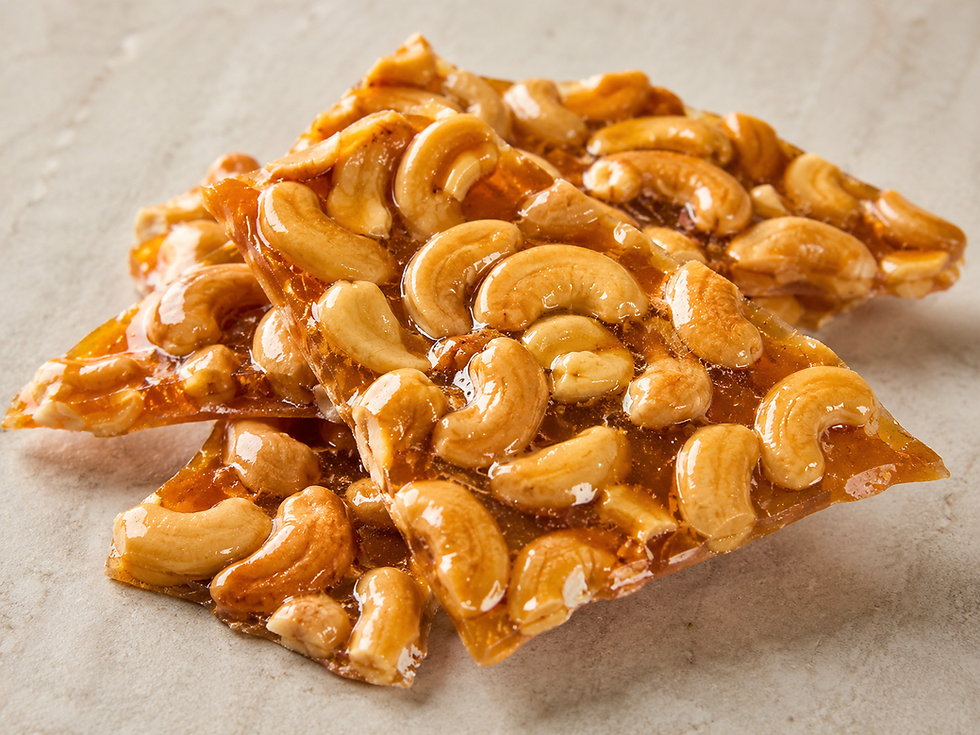
Pampanga sansrival, regional turron, and yema-based pasalubong often include a cashew brittle or cashew nougat layer. The cashew is set into a caramelised sugar or condensed milk matrix, then cooled and broken into shards. The original kernel shape is destroyed by the cooling and breaking process.
Any size cashew works here. The cooling and breaking process eliminates visual consistency in the kernel regardless of starting size. SP grade is the more efficient input specification, and the finished brittle is identical to one made with a whole grade.
Fruit cake and Christmas cake
The Philippine Christmas pasalubong fruit cake is loaded with chopped nuts, dried fruit, and candied peel. The cashew is one of several inclusions. By the time the cake is mixed, baked, sliced, and packaged, the cashew is a 5 to 8 millimetre piece sitting in a dense crumb structure.
Specifying whole cashews for fruit cake means transporting them, storing them, and then chopping them in-house before they go into the batter. SP grade arrives pre-broken in roughly the right range for fruit cake inclusion. The finished cake is identical, with one less prep step on the production line.
Ensaymada and pandesal cashew toppings
Premium ensaymada lines and specialty pandesal products sometimes feature a cashew topping. In most cases, the topping is a finely chopped or sliced cashew mixed with sugar, butter, or grated cheese. The customer perceives a cashew presence. They do not perceive whole kernels.
For these toppings, LP (Large Pieces) is sometimes specified because the producer wants a visible chunk on top. For finer toppings on smaller-format products, SP is the more efficient input.
Cashew tart and bar cookie fillings
Cashew tarts and cashew bar cookies often combine a chopped cashew filling with a caramel or syrup base. The cashew is folded into the filling rather than placed individually on top. As with fruit cake, the chopping has to happen somewhere. SP grade lets the factory do it instead of the production line.
The single application where SP is the wrong call is when the whole kernel is the visual hero of the product. Whole cashew pralines, premium cashew gift boxes, garnish-style placements on top of tarts. Those need W180 or W240, and there is no substitute. For everything else where chopping or grinding is part of the recipe, the specification question is worth surfacing as part of a periodic procurement review.
The cost math, with 2026 market pricing
Per-kilogram prices move week to week with harvest, freight and currency. The spread between grades is more stable, and that spread is what the procurement case rests on.
At origin, small pieces traded at roughly half the price of W320 through 2026. A July 2026 Vietnam FOB price list put SP at US$1.40 to 1.60 per pound against US$3.10 to 3.35 for W320 (Der Auditor via Mundus Agri), and November market reports quoted the same pieces bands. Broker quotes on 6 November 2026 put SP at about 65 percent of the WW320 price (CMBroker). Across sources, SP sat at roughly 45 to 65 percent of W320, and LP at about 64 percent.
Grade | Vietnam FOB, USD/lb (Jul 2026) | Approx. USD/kg | vs W320 |
W240 | 3.45 to 3.60 | 7.61 to 7.94 | About 109% |
W320 | 3.10 to 3.35 | 6.83 to 7.39 | 100% |
WS | 2.60 to 2.75 | 5.73 to 6.06 | About 83% |
LP | 1.95 to 2.20 | 4.30 to 4.85 | About 64% |
SP | 1.40 to 1.60 | 3.09 to 3.53 | About 47% |
These are origin trade quotes for standard quality, not Manila prices. Freight, duties, warehousing and distribution add to every grade, which narrows the percentage gap at the landed level, but the order of the grades does not change.
Direction matters as well. Vietnam's average kernel export price has held above US$7,000 per tonne since April 2026, and November reports describe both large whole kernels and quality pieces as tight. Do not plan on prices easing before the October to December pasalubong peak.
For a producer using 300 kilograms of cashew a month on Bucket 3 SKUs, every US$1 per kilogram difference between grades is worth US$3,600 a year. On the Cashews.PH price list the gap between W320 and SP is US$3.60 per kilogram at the 20 kilogram tier, which works out to about US$12,960 a year at 300 kilograms a month, before counting the chopping labour SP removes.
Price note: Cashews.PH prices are indicative and change with each import shipment, freight and exchange rates. Last updated 14 November 2026. Request a quote for current pricing.
The procurement principle is structural. The cashew specification should match what the finished product requires. Where it already does, the specification is correct as it stands.
Where a periodic review surfaces a gap, the four-step trial method in this article lets the team validate a change against a single SKU before any portfolio-wide decision.
What changes operationally if a specification moves from whole to pieces
For teams whose procurement review surfaces a specification change from a whole grade to SP, three operational things change. None of them are dealbreakers.
First, the visual appearance of the incoming raw material is different. SP grade looks like pieces, because it is pieces. Quality control teams trained on whole kernels need a five-minute briefing on what SP should look like at intake. Color, moisture, foreign body controls, and lot documentation remain the same.
Second, the kitchen step you used to do (chopping or grinding the whole kernel) goes away. For most pasalubong producers this is a small labor saving. For larger operations with dedicated cashew prep, it can be a meaningful equipment utilisation shift. There is also a secondary benefit: in-house chopping of whole kernels in high-impact mills often produces an inconsistent particle size distribution, with some fragments over-grinding into a wet paste that releases free oils. Pre-graded SP starts at a tighter size distribution and reduces that variability.
Third, your supplier conversation changes from "I need W320, when can you deliver?" to "I need SP grade meeting AFI standard, with current crop documentation, in 20 to 25 kilogram vacuum-sealed packaging." The second conversation is the same as the first, with different grade specifications. Any wholesale cashew supplier that cannot have it without a long pause is not the right supplier.
A four-step production trial before any specification change
A grade switch should be treated as a controlled production trial, not a blind purchasing swap. The following four-step methodology lets a procurement and product development team validate a specification change against a single SKU before rolling it across the portfolio.
Step 1. Choose the right test SKU. Start with a SKU sitting in Bucket 3 (functional grade applications). Cashew polvoron is usually the strongest first test because the cashew is fully integrated into the base and the customer expectation is flavor and crumb texture, not whole-kernel appearance. Avoid starting with a premium visible-topping SKU.
Step 2. Run a side-by-side batch. Use the same formula, the same roast condition, the same batch size, and the same mixing time. The only variable changed is the cashew grade. Run one batch with your existing whole-grade specification and one with SP. Production conditions held constant.
Step 3. Score five sensory and operational variables. Rate both batches on flavor release, finished texture, mouthfeel, mixing consistency, and finished-product appearance. For polvoron, weight texture and flavor release highest. For fillings, weight dispersion and mouthfeel highest. Use a small internal panel (three to five people) for sensory scoring, not a single tester.
Step 4. Calculate true finished-product cost impact. Do not stop at raw ingredient cost per kilogram. Include the cost of in-house chopping or grinding labor on the whole-grade batch, processing loss and fines, roast behavior differences, and total production time. The grade that produces the same finished product at lower total cost is the new default for that SKU.
If the SP batch scores indistinguishable from the whole-grade batch on the sensory variables and lower on total cost, the specification change is defensible. If sensory scores diverge meaningfully, the test has told you the SKU does not belong in Bucket 3 and should stay on its current grade.
What to ask any wholesale cashew supplier before you switch
If you are evaluating a switch from whole grade to SP grade for any of your pasalubong lines, the supplier qualification questions are the same ones you would ask for any new ingredient line.
Ask for the food safety certifications held by the processor. ISO 22000:2018, BRC Global Standard for Food Safety, HACCP protocols, US FDA registration, and GACC registration (the China General Administration of Customs registration that enables export to multiple Asian markets) are the baseline you should expect from any reputable processing partner. If your supplier cannot show you a current copy of the relevant certificates for the specific facility producing your lot, that is a red flag.
Ask about physical contamination controls at the processing facility. Reputable Vietnamese cashew processors run color sorting, X-ray scanning, and metal detection on the production line before vacuum packing. These controls protect against the foreign-body risks that are the most common failure mode in agricultural commodity processing.
Ask for crop year confirmation. Cashews are harvested seasonally, and crop year matters for moisture, oil content, and shelf life. Current crop SP grade should be the default specification.
Ask for AFI standard conformance documentation. The Association of Food Industries grading standard is the international reference point for cashew kernel specification. Any supplier importing into the Philippines should be able to issue lot documentation referencing AFI grades, sieve sizes, moisture, defect tolerances, and packaging.
Ask for sample protocols. Request a 5 to 20 kilogram sample of the SP grade you are considering, run a single production batch with it (the four-step trial above), and compare finished product against your current whole-grade output. Texture, flavor, and visual appearance in the finished product should be indistinguishable. If they are not, the grade was the wrong one or the supplier sourced from the wrong processor.
Ask for the supplier's import capacity, MOQ, and lead time terms. For pasalubong producers planning a seasonal ramp, knowing how much cashew the supplier can deliver in October to December matters more than headline pricing. A supplier that scales imports to demand and keeps a 20 kilogram MOQ can serve both a regional brand running 100 kilograms a month and a national chain ramping to several tonnes per quarter.
The decision in one sentence
For pasalubong applications where the cashew is chopped, ground, folded into a filling, or baked into a crumb structure (polvoron, hopia, fruit cake, brittle, ensaymada toppings, tart fillings) SP grade delivers the same finished product as W320 or W240 at materially lower input cost. For applications where the whole kernel is visually presented to the customer (premium gift boxes, garnish-style placements) whole grades remain the right specification. The question for every pasalubong line should be: does the customer see a whole kernel, or do they taste cashew? If it is the second, SP is worth a trial.
Frequently asked questions
Is SP grade cashew lower quality than W320 or W180?
No. SP grade from a properly certified Vietnamese processor is identical in nutritional profile, food safety controls, and origin to the whole kernels produced at the same facility on the same day. The only difference is kernel size and breakage. Lower price reflects lower presentation value, not lower quality.
What is the AFI sieve specification for SP grade cashews?
Under the Association of Food Industries standard, SP grade cashew kernel pieces pass through a 4.75 millimetre sieve and are retained on a 2.80 millimetre sieve. They must be white or pale ivory in color, cleaned of loose husks and foreign matter, and meet the same moisture ceiling (at or below 5.0 percent) as whole kernels.
What is the difference between SP and LP cashew grades?
LP (Large Pieces) is a coarser cashew piece grade, retained on the 4.75 millimetre sieve that SP passes through. SP (Small Pieces) is finer. LP is the right specification when a visible chunk of cashew is wanted in the finished product. SP is the right specification when the cashew will be ground, blended, or folded into a filling.
Will switching to SP grade affect the cashew flavour in my finished product?
No. Cashew flavor is determined by kernel chemistry, processing temperature, and freshness, not by kernel size. SP grade from a current-crop Vietnamese processor delivers the same toasted cashew flavor as W320 or W240 from the same processor.
Can I get SP grade in a 20 kilogram order, or do I need to commit to a container?
Yes. Cashews.PH supplies SP grade from a 20 kilogram minimum order in vacuum-sealed packaging, scaling up to full 40-foot container loads. The 20 kilogram entry point is designed to support sample runs, pilot batches, and smaller regional producers.
What certifications should I expect from a reputable Vietnamese cashew processor?
The baseline certifications to ask for are ISO 22000:2018, BRC Global Standard for Food Safety, HACCP, US FDA registration, and GACC registration. Reputable processors should be able to provide current copies of all of these on request, specific to the facility producing your lot.
How do I run a controlled trial before switching specifications?
Use the four-step method in this article: choose a Bucket 3 SKU, run a side-by-side batch with the only variable being the cashew grade, score five sensory and operational variables (flavor release, texture, mouthfeel, mixing consistency, finished-product appearance), and calculate true finished-product cost impact including in-house labor and processing loss, not just raw ingredient cost.
Talking to Cashews.PH about SP grade
Cashews.PH supplies seven cashew grades to Philippine bakeries, manufacturers, hotels, and retailers, with import volume scaled to demand and a minimum order of 20 kilograms. Our processing partners in Vietnam hold ISO 22000:2018, BRC Global Standard for Food Safety, HACCP, US FDA, and GACC certifications. SP grade is one of the most-requested specifications across our pasalubong, bakery, and confectionery customer segments. A leading Philippine bakery brand specifies Cashews.PH as its cashew supplier across multiple SKUs.
Samples are available. Quotes are returned within one business day. If your team is reviewing your cashew grade mix this quarter, that conversation can start with a single email.


Comments